In the Hot Seat with Dr. Sarah Perkins-Kirkpatrick
Written by:
Alex Varni
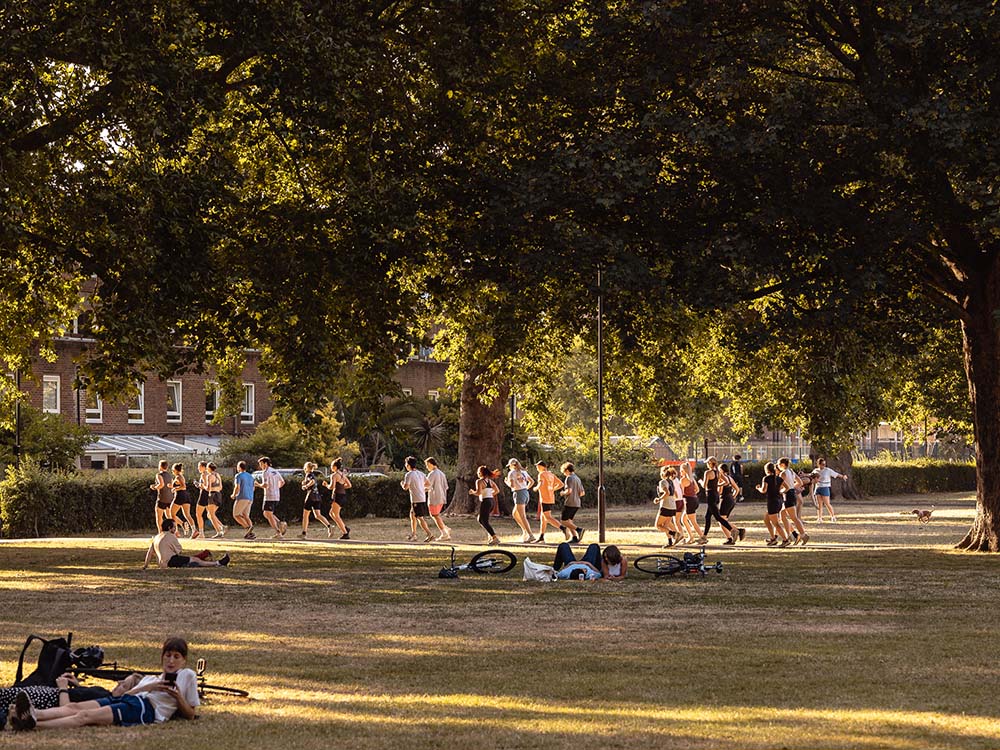

Professor of Climate Science at Australia National University
Mitigation alone won’t save us from the heat: We need to adapt
Over the last few months, we have sat down with academics and industry experts from London to LA who are working on extreme heat and adaptation. They have shared valuable insights into how climate research and our understanding of extreme heat are evolving as cities around the world get hotter.
For our latest interview we spoke to Dr. Sarah Perkins-Kirkpatrick, Professor of Climate Science at Australia National University about the increasing severity of extreme heat events around the world.
Alongside her role at ANU, Dr.Perkins-Kirkpatrick is also a science communicator with media appearances including a recent TEDtalk, and a weather-related podcast, Totally Cooked, which she co-hosts. Through our conversation we explore Dr.Perkins-Kirkpatrick's work around the health impacts of extreme heat and the growing threat this poses for communities globally.
Our 'Hot Takes' from the conversation with Dr. Perkins-Kirkpatrick
- Reaching net zero won't make heatwaves disappear. We need to adapt to the climate we are already experiencing.
- The greatest heat risks are often felt in communities around the world with the least capacity to adapt.
- Many of the most heat-vulnerable regions of the world are also the most underrepresented in heat-related data and heat research.
- The solutions to improve heat resilience are well-understood, what we lack are the policies and funding to deliver them at scale.
- Building resilience means closing gaps in knowledge, investment and action.
Thank you so much, Sarah, for joining us today. We're really excited to talk through some of your research and the issues surrounding extreme heat.
Knowing that a lot of your research focuses on climate change and the impacts of extreme heat, could you walk us through your background, what initially brought you to the study of climate change and what drew you to extreme heat, in particular?
I guess going all the way back to my schooling years, I realised that science was a thing for me. But, once I started university, I realised very quickly that I didn't like working in a lab or doing field work. On top of that, I was already showing an interest in climate research and meteorology. And I just happened to be doing a degree that explored these areas at the time.
Thinking about what made me go into research and start to research this further, it was just a series of fortunate events, I guess. I decided that I wanted to do a higher research and a higher degree. The person who I spoke to, who later became my supervisor, had made a suggestion around looking at extremes and how climate models can replicate them and project them into the future. And I think that seeded me down that trajectory of looking at extreme events. I remember sitting in a conference here in Australia in 2009, and we just had a really bad bushfire disaster here. And it was preceded by a really, really, really bad heatwave: still the most intense heatwave for that region ever recorded. And it made me think, gosh, is anyone researching these things? Do we know how they're changing? Do we know how to define them? Do we know anything about them? That was 17 years ago now. That really set the stage for me to go into heatwave research. That was at the end of my PhD. And I've forged my career from that.
We now know a lot, not just because of me, of course, but we now know a lot about how to measure heatwaves, what drives them, how they're changing, their health impacts, arguably the most well-studied extreme climate event and extreme weather and climate event that exists. So, clearly everyone's interested in them, which is a good thing. I was drawn to that in different ways throughout my career.
Much of your research is focused on health impacts and thelife-threatening conditions that surround heat. Could you walk us through theconcept of wet bulb temperature and how this might differ from temperaturemeasurements that people are used to seeing, maybe, on their phone. Why is wetbulb temperature important for understanding heat’s impact on human well-being?
Yeah, that's a good question. So, wet bulb is a concept that most people outside of meteorology or climate science don't really understand. I would even argue some of us don't understand it.
It is essentially measuring how much moisture an air parcel, we use the term ‘parcel’, but that's very vague: how much moisture a certain amount of air is holding. So, the warmer the air, the more potential it has to hold moisture in it. And when I'm talking about moisture, I'm talking about water vapor, which is the gas of water effectively. So, higher temperatures can hold more moisture. Doesn't mean they hold that moisture, though. What the wet bulb temperature is measuring is what the temperature that air would be if it was fully saturated. So, a lower wet bulb temperature means that the air would be at a lower temperature if it was saturated and so on and so forth.
We use a threshold called T, well, we used to use a threshold called the wet bulb 35 threshold, which was saying that the air would be 100% saturated at 35 degrees Celsius. And that is really not great for humans because if the air is fully saturated, there is no room for the moisture that you're exerting through sweating to be absorbed into the atmosphere. And we need that. That's a really fundamental mechanism to keep us cold. At a wet bulb temperature of 35 or higher, the gradient between the temperature of our skin, and effectively our core body temperature, and the air is too low for that moisture to transport. At lower wet bulb temperatures, it's easier for the moisture to evaporate into the air.
Even reaching wet bulb temperatures of 35 degrees Celsius, it has happened, but only for short periods of time and only very, very recently in selected parts of the world. But there was a study that came out over 15 years ago now that said that the wet bulb 35 threshold is the uppermost limit of human survivability. But it turns out that threshold is still the highest theoretical maximum that we could potentially survive at. But it turns out because, we move, we wear clothes, we have different levels of functionality, of health, of age, and metabolic rates, that all goes into lowering those survivable thresholds to something more realistic.
Wet bulb is effectively saying: at a temperature, this amount of this air is completely saturated, and the higher the wet bulb threshold, the worse the conditions are.
At what wet bulb temperature might we expect to see vulnerable populations experiencing maybe heat-related illness or heat-related mortality?
So, if you're older, you're looking wet bulb thresholds quite a few degrees lower, especially at higher temperatures. Because what happens when you're older, your ability to sweat is reduced and you're much more affected by higher temperatures.
So, suddenly, if you're experiencing temperatures of50 degrees Celsius, the difference between a wet bulb temperature of 35 degrees Celsius and what wet bulb temperature is detrimental to an older person is...well at 50 degrees Celsius, you don't need any humidity in the air for it to be problematic. You're just going to cook anyway. So, that's where that difference is. It doesn't have to be that constant heat and humidity. At hotter temperatures, the humidity doesn't matter anymore.
Yeah, that's really interesting to hear as well. Obviously, humidity plays a role, but at some levels of heat, it's just the heat itself is such a problem.
Well, this is it. And this is what we saw in some of the heatwaves that we looked at, the temperatures were just really bloody hot. There's no other way to put it. And yes, as you said, heat and humidity matters, particularly at hot temperatures, but really high humidity because of the reasons I just explained. But when it's really, really, really hot, you basically cook. There’s no other way to put it. You can't replenish the moisture in your body fast enough at the rate it's being sucked out because of that really large gradient between the really hot and dry air, and your body.
We know that human-caused climate change has really impacted the frequency, but also the duration and severity of extreme heat events. Could you tell us how climate change has impacted that and how is that change projected to increase going forward?
Yeah, good question. So, I think this is one of the reasons why heatwaves are the best understood climate extreme event or hazard or however you want to phrase it. There's a very strong link, a very sensitive link, between average temperatures and extreme temperatures. So, this may be a bit too much, but we describe it like a bell curve, like a distribution that's symmetrical and it peaks in the middle around the average and then peters out at either side, which is where the extremes are. If you shift that average part by just a couple of degrees to warmer conditions, you're suddenly seeing a vast increase in the frequency of what used to be an extreme event, as well as the intensities that those extreme events reach.
Right, so it's just a simple shift, not always, but mostly a simple shift in average conditions blows out the frequency and intensity and therefore the duration of heat extremes. And conversely, on the cold extreme scale, it tends to make them less frequent because everything's just shifting to a warmer climate. Now, that's like the basic underlying properties. Sometimes the dynamics that help heatwaves manifest, so changes in El Niño Southern Oscillation, for example, or land surface interactions or synoptic systems, they can change too. But by far and large, the changes that we're seeing are because conditions are warming by 1 to 2 degrees Celsius.
And then unfortunately, because climate change isn't done yet, we're expecting that to get worse in the future. And ultimately, how much we warm is up to us and the actions that we take or don't take. And will have a knock on effect to heatwaves down the line too.
Another study I did last year looked at what heatwaves would look like in a net-zero world. So, when, if any time, would heatwaves start to decline and revert back to pre-industrial conditions after we do reach net zero? And the spoiler alert is they don't. The earlier we reach net zero, the better, and the less affecting heatwaves will be. But for most parts of the world, heatwaves just tend to stagnate where they were when net-zero is reached, except for Australia, where they keep continuing up because of local scale interactions. That was a bit of an eye-opener even for us climate scientists, because it showed that net-zero was not the panacea we all so want it to be. Don't get me wrong, it's necessary, but things aren't going to necessarily improve after net zero. They'll just stop getting worse.
As you said, that can feel a little disheartening. But I think this also highlights the need for adaptation and the practical actions we can take to build resilience despite these challenges.
Our understanding is that a lot of climate change research, in general, has been centered in the Northern Hemisphere. From your perspective, as a researcher based in the Southern Hemisphere, why is it important and valuable to increase our understanding of heat risk in the Southern Hemisphere in particular? What regions are particularly vulnerable and in need of additional research?
That's an excellent question because, as you're saying that, I'm looking at the figures of this paper, I'm seeing we only did one region in the Southern Hemisphere and that's where I live. So, there is selection bias there for sure. But I'll start with your second question, first.
There are areas, not just in the Southern Hemisphere, that are far more prone to these deadly heatwaves already, or deadly heat events, that are deadly physiologically, not just because we've found a statistical association. And they're the regions closest to the tropics or in the tropics. So that's north and south of the equator.
And often not only is the climate conducive to these sorts of conditions, but we do have more vulnerable populations there, less adaptive capacity, unlikely to be actually measuring the mortality signal associated with these events well, or even the morbidity signal.
Certainly in terms of vulnerability, that's very clear, but also in terms of observations to actually detect these events in the first place. We are doing better these days with remote sensing from satellites and products that we call re-analyses that mix together observations and models and satellites. But we still struggle over a lot of the Global South, so large parts of Africa, for example, and South America. It's not to say the data is not there, but we just don't have enough of it. And that makes it hard to detect the event, whether its via remote sensing or on the ground via lived experience or what we call in-situ data.
I guess the too long to read version of that answer is the lack of resources does seriously inhibit how we can detect these events, monitor them, attribute them, realize their full impacts. But yes, these are huge hurdles to overcome. In saying that, it doesn't mean that wecan't start doing something now, even if the certainty bounds are wider or that our confidence intervals are a bit wider, so we have less certainty.
I am, again, hand on heart, absolutely confident that we would still find, firstly, the impacts of heatwaves in those regions, as well as an attributable signal to human activity.
It seems that there's almost two parallel problems, one of potentially greater vulnerability and risk, and then at the same time a lack of data for understanding and informing solutions to that. But it's also great to hear your message of hope: that it is valuable and important research and we should continue carrying on in pursuing it.
Absolutely, 100%.
I know that you've done a lot of work in the science communication space, whether it's with the news media or recently with a TEDtalk, I believe. How has your experience been with science communication and what has the experience of communicating these issues taught you?
So, I think one big reflection, and I continue to have this all the time, is what I think people know and what they actually know about this topic is worlds apart.
And that's okay. That's no one's issue. It's not saying that people who are non-scientists are dumb or don't know enough or they're not doing a good enough job. But I think it's actually more of a comment on academics being so stuck in their niche and doing what they love. And that's great. And, you know, focusing on the task at hand and what needs to be done to get it to a high degree of accuracy, that they forget about what's really known in the outside world. And not all academics want to be communicators. And again, that's totally fine. But that constantly needs to be refreshed. And I think the TEDtalk was really good for that. It made me really boil stuff down to general levels. And even the podcast that I host, it's a shameless plug, Totally Cooked. It's about climate and weather and we keep it at a very general level. That's been a huge eye-opener for me too.
And I distinctly remember one conversation between my now co-host, Iain, and the company that we used to help get the podcast up and going and just getting advice from them. And I was talking about something called the climate stripes and how we had to have an episode around that. And everyone kind of looked at me and I said, you know, the climate stripes, everyone knows what they are. And everyone, including Iain in the room, said, “no, we don't”. I was just so shocked, like the blood drained from my face. I thought, “how do you not know this? where have you been?”, and I showed them a picture of that. Immediately , they all got it because it's just such a wonderful piece of visual work. I know the creator of them quite well. They all say they know it but they didn’t know the concept by name, and that was an eye-opener.
It makes me realise that there is no assumed knowledge here. That was the point. So, when we're doing the podcast, I have that always in my mind now. When I started writing my TEDtalk, I had that in my mind, but it was refreshed again and again and again as I worked on the script more. There is no assumed knowledge. Sometimes people do know and then maybe if you're nimble enough, you can work on that and change your message slightly to reach where they're at. But you should never assume that the audience knows anything about what you're going to talk about. And again, that's okay.
Yeah, I think that's a really great point in science communication in general.
So, coming towards the end here, I'm interested to ask what barriers do you see in your field at the moment? What barriers might you want to see removed in order to affect greater positive change?
I think first and foremost would be policy. We need a long-term strategy and we already know what we need to do. We could do much more research and definitely want more research money, and I'll get to that. But policy change will ultimately make these impacts much less severe, right? We've got to do it. End of story. And widespread, not just in the UK, not just in Australia, but everywhere. And it's got to be permanent, not just something that's based on a political cycle.
Funding would be amazing, and I'm not saying that for my own benefit, just so I can research the things I like. But a lot of this work is interdisciplinary, and this particular study was a labour of love between a bunch of scientists. We weren't funded, we didn't have grant funding for this particular study. It wasn't based on that.
It's so hard to get funding for interdisciplinary work. I know there's a few funding organisations, but none that are homegrown here in Australia. And that makes it really hard to have that mechanism and to allow people from interdisciplinary backgrounds to work together. And we've tried, one of the co-authors, Ollie Jay, and I have tried multiple times to get funding together in an interdisciplinary way and we get knocked back. And it's very, very, very frustrating because we'd be so much further along with this research if we had those mechanisms in place.
I agree, it’s a really important reflection on the interdisciplinary piece of it. Climate change is a problem that necessitates interdisciplinary work. And the fact that funding for work across disciplines is not widely available - that seems like something straightforward that we could try to fix, particularly because of the gravity of the challenge that we face.
100%. Well, this is the thing. I literally said in myTEDtalk, we know the solutions. We know what they are, we've just got to rollthem out. That's all it takes. It's not like we're starting from scratch, farfrom it. So it's just a matter of getting on and doing it.
Okay, well, thank you so much again, Sarah, for joining us today. It was really amazing to hear all of your insights through your research and also our discussions around science communication!
Cool, anytime, Alex. All good, happy to be on.
Thank you, Sarah. Have a nice night.
Alright, you too. Bye bye.
Further reading (and listening!):
- Check out the Totally Cooked Podcast (co-hosted by Dr. Perkins-Kirkpatrick)
- Check out Dr.Perkins-Kirkpatrick's recent Tedx Talk
- Perkins-Kirkpatrick, S.E., Gregory, C. H., Vanos, J. K. et al. (2026). Deadly heat stress conditionsare already occurring. Nature Communications, 17, Article 2590. Link to article.
- Perkins-Kirkpatrick, S.E., Alexander, L. V., King, A. D., Kew, S. F., Philip, S.Y., Barnes, C.,Maraun, D., Stuart-Smith, R.F., Jézéquel, A., Bevacqua, E., Burgess, S.,Fischer, E., Hegerl, G. C., Kimutai, J., Koren, G., Lawal, K. A., Min, S-K,New, M., Odoulami, R. C., Patricola-DiRosario, C. M., Pinto, I., Ribes, A.,Shaw, T. A., Thiery, W., Trewin, B., Vautard, R., Wehner, M., and Zscheischler,J. (2024) Frontiers in attributing climate extremes and associated impacts.Front. Clim. 6:1455023. doi: 10.3389/fclim.2024.1455023