In the Hot Seat with Dr. Samuel Lüthi
Written by:
Alex Varni

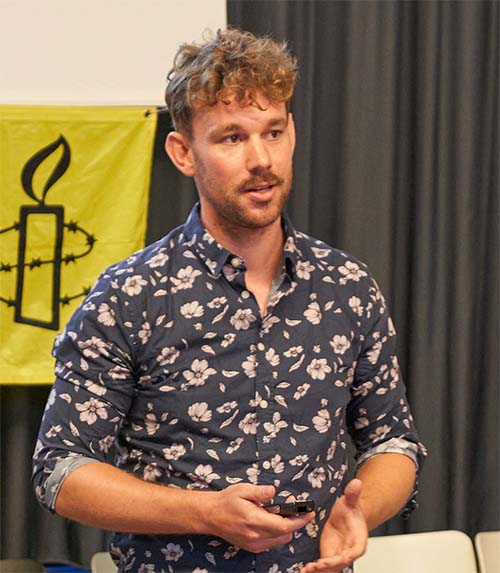
Postdoctoral Researcher at the University of Bern
The heat is on: why climate adaptation must put people first
Over the last few months, we have sat down with academics and industry experts from London to LA who are working on extreme heat and adaptation. They have shared valuable insights into how climate research and our understanding of extreme heat are evolving as cities around the world get hotter.
For our next In the Hot Seat, we spoke with Dr. Samuel Lüthi, a Postdoctoral Researcher at the University of Bern who studies the impacts of climate change and the risks of extreme heat. We talked about how heat and other climate risks impact vulnerable people the most, and why adaptation efforts should help protect them first.
Our 'Hot Takes' from the conversation with Dr. Samuel Lüthi
- We don't just need technological innovation, we need social innovation.
- Many of the solutions to extreme heat already exist, the challenge is making them accessible and widely adopted.
- Effective adaptation requires better policies, community involvement and a fairer distribution of resources.
Thank you so much again, Sam, for joining us today! I'm wondering if you could start off by telling us a bit about your background and what drew you to the study of climate change originally?
Sure, thanks for having me. I originally studied environmental sciences at ETH in Zurich. The reason I was first drawn to this area was that after finishing with gymnasium (the equivalent to high school) I did an internship with a re-insurance company in Switzerland. There, obviously, natural catastrophes were quite a big consideration. I found the idea of climate extremes super interesting. This was also the time when the Intergovernmental Panel on Climate Change (IPCC) 5th assessment report, I believe in 2013-2014, was released. This was the first time I really got closer to natural catastrophes and their impacts including climate extremes.
I saw that there was an interdisciplinary bachelor's that tries to bridge these. Since then, this fascination just kept growing. I think it moved away from storms a bit, towards heatwaves and how heat impacts societies. I just found it very fascinating, honestly. Also scary and frustrating at times, but also interesting to spend my days with it.
You mentioned the IPCC and how that played a role in your journey as well. Could you talk us through the IPCC's concept of climate risk with hazards, exposures, and vulnerabilities? In a heat wave, what would be the hazard, what are the exposures, what are the vulnerabilities?
The way the IPCC thinks about climate risk is actually quite simple. Risk comes from the interaction of three things: the hazard, exposure and vulnerability.
The hazard is basically whatever the climate is going to throw at you. So, this can be a heatwave, it can be a storm, a wildfire, an earthquake. Then, the exposure is typically what you care about. So, that can be your home, this can be your insurance portfolio, this can be your population, or also specific sub-populations. Then, the vulnerability is basically linking the hazard to the exposure. So, how does your exposure, your population, react to a given hazard, to a given heat wave? At what temperature does the risk of mortality really start to rise?
So, in heat mortality, we need to tweak the logic because we calculate heat mortality as an excess mortality. So, obviously people die each day, but you have more people dying during heat waves. So, we actually take the daily mortality counts as our exposure in the model, but that's more the mathematical formulation or the methods to it.
A lot of your work has looked at how climate change contributes to heat-related deaths. How has the risk from extreme heat changed over time, and what role has climate change played in that?
Heatwaves are probably the climate extreme where we see the strongest climate signal. There's both the change in frequency and in intensity of heatwaves. What would have been barely possible in a pre-industrial climate, so in a world without climate change, is now increasingly becoming normal. Very prominent heatwaves like 2003, or also 2022 in Europe, and 2018 would bear a very, very low likelihood in a world without climate change. Obviously, we live through these heatwaves, so we see that this becomes possible and increasingly more frequent.
And then also the intensity, heatwaves are just becoming more extreme. We often think in probabilities, so we've mapped these probabilities to return periods (how often an event of a particular magnitude is expected to occur on average). And basically, we say that very rare events are now more frequent, but also the new rare events are much more extreme. And both are obviously quite a challenge for us.
I think what we showed in past research is really that these rare events, like a 1 in 100 year return period in the climate of 2000 – this is already when there’s a lot of climate change, right? – in the current climate those 1 in 100 year events are now more or less 1 in 20 year events. So, there's this massive increase in probability or reduction in return period.
So, I think climate science has talked about this already for quite a while. When I did the analysis during my PhD, I was a bit like, whoa, this is quite a message. But then, in the summer of 2003, we saw an excess mortality of roughly 70,000 people in western Europe. And then in the summer of 2022, we also reached 60,000, right? So, 2003 was completely unexpected, outside of anything we had ever seen. And with summer 2022 nobody was really surprised. So, these extremes becoming more and more normal, that's the world that we live in.
The 2022 heatwaves brought record temperatures to London and led to unprecedented wildfire events across the city. I know your doctoral research also explored wildfires. As climate change increases the risk of both extreme heat and wildfires, how can communities become more resilient to multiple climate hazards at the same time?
It's a good question, but also a tough one. One thing I always want to put first is the idea of risk management: ‘avoid the unmanageable, manage the unavoidable’. So, avoid the unmanageable is always important and this means phasing out fossil fuels as rapidly as possible. Not further amplifying the climate crisis is for sure a very good start in any climate adaptation discussion. Avoid the unmanageable is always a key starting point.
We obviously live in the world experiencing a climate crisis, so manage the unavoidable is also important. And I think what is very, very common is overlaying who is at risk and identifying vulnerable populations. For epidemiology, this is the foundation of everything. Who suffers most during heatwaves? Typically, elderly people, people with preconditions, people that need to work outdoors, people with chronic diseases, mental health patients. So, making sure these vulnerable groups are okay and can withstand this with dignity during a time of crisis is a no-brainer. But it's very hard to do. It needs good adaptation planning.
And then, on the more structural side, I think that this is where it gets really interesting, because, for example, a lot of western European cities put urban greening at the front of climate adaptation. Which is nice: everybody likes green spaces, everybody likes trees, and it makes cities more liveable. So, you should definitely do that, but there are some cities in, I believe in Portugal, but also southern US, that actually are very wildfire-prone regions that don't support urban tree planting because they could transmit fires. So, I think as these climate zones start to shift, I'm not saying don't plant urban trees, definitely not, but be aware of intersecting hazards. Adaptation is very context specific. So, for the city of London I’m a bit too far away, but I think starting off with your vulnerable population is always a very, very good idea, making sure they're doing okay. That’s always a good place to start.
And also making sure this is not forgotten in adaptation planning. There are a lot of projects in European cities that plan new districts with very nice greening and climate-adapted buildings. But what happens is also green gentrification: that people who lived there get pushed out and wealthier people come in. And especially as heat is such a social climate extreme, if you have access to air conditioning, to a swimming pool, you can create a home office. But if you live in a room with two people, no air conditioning, in an old building that heats up, and you can't leave the city because you can't afford it: then you’re suffering
When we have several crises at once, such as during COVID, these effects compound for those most vulnerable. When libraries and other public cooling spaces were not available in cities such as LA, it was typically homeless people that then didn't find cooling. And at the same time, they had a lot of wildfires during that time, so they had really bad air quality. And so it was homeless people, who often already have health preconditions, who are then exposed disproportionately to bad air quality, to heat. And it's following these lines, very anecdotal lines, that I think always helps with how you make sure no one is left behind during the crisis or during the climate extreme.
How might policymakers and practitioners go about incorporating predictions from climate models into their emergency planning and adaptation around extreme heat?
Looking forward, for heat, I think three things are typically important. These are changes in the mean temperatures of summers. In Western Europe, typically, our summers are by now already two or three degrees hotter than they used to be. Then, it's the known extremes becoming more frequent, and it's the new extremes, too. As I said before, they all have one thing in common: you should start with your vulnerable groups first and understand who bears the consequences during time of crisis.
I think there's also different ways to adapt to these. So, for the new means, it's a lot of structural adaptation. So, despite what I critiqued before, urban greening is a good thing, I believe. With infrastructure, I also think air conditioning is a good thing, although that's an ongoing debate in climate adaptation. I always say, myself, I live in the middle of Zurich in a rooftop flat, and so I sometimes sleep at like 28 to 29 degrees at night. Take it from someone who doesn't have air con. I wish I had it. So, I feel I'm entitled to have an opinion.
I think it's very important that as cities, as societies, we are not surprised by new events. This is where climate science can really help by saying, ‘hey, this is what's in the room, that's what could be plausible’. I think in climate science currently, storylines (a plausible, evidence-based narrative that explores how a climate-related event or risk could unfold under specific conditions) are en vogue. But we should really try to move away from these probabilistic views, so rather than saying, ‘hey, this heatwave could be happening, so it could be very extreme’ we try to instead say: what would this mean on a city? How could emergency services be affected? Is the electricity safe during such a heatwave, because it's quite a stress on the system? Who would suffer? Who would we need to protect?
In starting, don't explore everything that could be possible, instead do a couple of storyline scenarios to help. Also, co-create them with policy makers, with people living there to have a bit of a feeling about what would happen. You're not going to live through the exact heatwave that you planned for, right? But if you planned well, that's what we call robust adaptation. And I think this is quite a nice way of thinking of it. So, this robustness is identifying options that work under a very broad set of scenarios of extremes. So, that if you prepared for a really bad heatwave and a bad, not as bad, but still a bad heatwave comes, you can still pull this out of your drawer and say, ‘okay, actually, we have a couple ideas’. This also helps to make the knowledge from climate science more accessible.
On that note of storylines and how we can connect this to the experiences that we see in our cities, I'm interested to ask: has there been a development recently that's caught your eye, whether it's a film, podcast, or article or something in the media space that has captured that storytelling around climate change well? And what about that resonated with you?
So, there's one documentary on Hurricane Katrina on Netflix. And it's really what we were talking about before with these social aspects during a climate extreme. It really highlights that so well. In the documentary, rich people got an early warning. They leave the city for the time of the disaster. They might have lost their homes, but not their lives. It really focuses on who could not afford to leave the city and how this intersects with black communities in the case of New Orleans and with poor communities and how this interacted with a very racist system. It’s incredibly interesting to see who suffers. So, for climate adaptation, I think it's a very interesting point to start.
That's really powerful. When you look at your area of research what change would you really like to see to make the greatest positive impact? What do you think are the biggest barriers to heat adaptation?
What I would love to see more of is a bit around the theory of change and what drives change. I think we are very used to technologies driving change, and we should get away from this in the climate adaptation space. Because we have enough technologies. The challenge is making them affordable, making sure that people want them, so that we can really scale them in a socially-just way. That people who need it can afford it, and people who can afford more are actually made to pay for them.
I think that is also a bit of an area of innovation. Innovation is very often connotated with technologies, and I feel we need social innovations looking at how to make voices heard, how to make sure no one is left behind. How do we make sure that these policies find their majority and people are not scared of these changes? That's the bit that I would rather wish for. I'm not sure how to get there though.
I think the goal is really important. And I think that's a great message to wrap up on here: how can we work together across practice and research to bring adaptation forward in a way that involves everyone and ensures that our most vulnerable communities are protected first and foremost.
Yeah, exactly, exactly. That's the message.
Well, thank you so much, Sam, I'm very happy that we could talk through a lot of your work and it was a very exciting conversation today!
Yeah, definitely. Thanks a lot for reaching out and for your work too. Have a good week!
Further Reading:
- Lüthi, S., Fairless, C., Fischer,E.M. et al. Rapid increase in the risk of heat-related mortality. NatureCommunications,14, Article 4894 (2023). Link.